ADOPT A HUMPBACK WHALE
Whale hello there — meet the ocean’s most magnificent traveller.
ADOPT A HUMPBACK WHALE
Whale hello there — meet the ocean’s most magnificent traveller.
Oceans Month invites us to explore and appreciate the wonders of our seas, including the remarkable humpback whale. These giants of the ocean captivate us with their powerful presence, graceful movements, and hauntingly beautiful songs.
Humpback whales are named for the gentle curve of their backs, visible as they dive beneath the waves. Their long, often white pectoral fins and striking black-and-white flukes make each whale unique, allowing scientists to identify individuals. These features remind us of the ocean’s incredible biodiversity worth protecting.
Along the southern African coastline, humpback whales undertake one of nature’s most inspiring migrations. After feeding on krill in the icy waters near Antarctica, they travel thousands of kilometers up South Africa’s east coast to breed and calve in warmer tropical waters. Their journey highlights the importance of healthy, connected ocean ecosystems.
A favourite among whale watchers, humpbacks are famous for breaching—launching their massive bodies out of the water before crashing back down in a spectacular display. Males are also known for their complex songs, which can travel for kilometers underwater, filling the ocean with sound.
During Oceans Month, we are reminded that while humpback whale populations have recovered in many areas, they still face threats. Climate change, ocean noise, ship strikes, pollution, and entanglement in fishing gear continue to impact their survival.
Protecting humpback whales means protecting our oceans.
What is WWF doing?
Whales are dependent on small pelagic fish as their prey, and recent research has shown that a decline in this prey can have negative cascading effects. WWF is working with retailers and fisheries on their journey toward sustainable fisheries and procurement, and to increasingly consider whales and other marine life in their operations.
WWF is also investigating an early warning system that aims to prevent whale entanglements in nets situated within aquaculture farms.
How does the symbolic adoption work?
By choosing a symbolic adoption, you’re making a meaningful decision to support the protection of our natural world. Your contribution helps conserve the beautiful—yet often fragile—environments that both people and wildlife depend on.
This makes a thoughtful and impactful gift for animal lovers, environmental champions, or anyone who cares deeply about the planet.
What you get
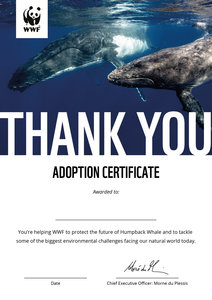
Certificate
A digital symbolic adoption certificate.
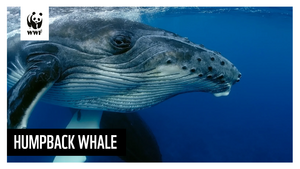
Photograph
A beautiful digital photograph.

Cuddly toy
An optional soft toy to love forever. *Toy may vary from image shown.
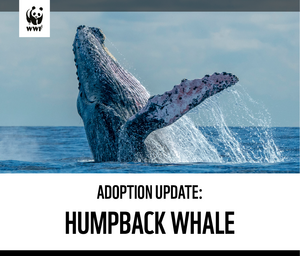
Regular updates
We'll keep you updated on how you're supporting our vital work including sending you adoption updates two to three times a year.
Did you know?

Humpback Whales are famous for their long migrations, travelling thousands of kilometres each year between feeding grounds in cold waters and breeding areas in warmer regions.

They are known for their spectacular breaching behaviour, launching their massive bodies out of the water before crashing back down with a huge splash.

Humpback Whales produce complex “songs” that can last for hours and travel long distances underwater, especially during the breeding season.

Despite their enormous size, Humpback Whales feed mainly on tiny krill and small fish, using a clever technique called bubble-net feeding to trap their prey.


